
For many people, scoliosis is initially just a word that causes more uncertainty than explanation. However, it involves something very concrete: a change in the
What scoliosis means – a clear definition
A scoliosis describes more than just a slight deviation of the spine. It refers to a lateral
Many patients are surprised when they learn how complex this term actually is. Because a spinal curvature is not simply a “crooked posture” but a structural bending that does not correct itself without targeted treatment. Therefore, it is important to understand early on what
Causes and risk factors of scoliosis
A scoliosis never occurs randomly. Behind it are concrete
Growth, puberty, and the course in childhood and adolescence
In children and in childhood, growth plays a central role. The faster the body develops, the more likely a deformation of the spine can increase. Especially in puberty, when growth accelerates rapidly in a short time, many cases become clearly visible for the first time. Idiopathic scoliosis – i.e., the form without clearly identifiable causes – is the most common here. Even if we cannot always explain its exact origin, we know typical patterns that help us in clinical practice to realistically assess the course.
Scoliosis in adulthood – late changes
In adulthood, other factors come into play: structural wear and tear, muscular imbalances, old injuries, intervertebral disc changes. As a result, an existing slight
Symptoms and typical complaints
Many patients do not notice a scoliosis through pain, but through visible changes in their body. Typical are uneven
Complaints usually arise later. These include pain in the lower or upper back, back pain after prolonged sitting or standing, and deep tension that cannot simply be trained away. Some affected individuals report that the change in the back is particularly noticeable under stress. If the curvature is more pronounced, the pressure on internal organs can increase – this mainly affects the chest areas that change due to the rotation.
Important: Symptoms do not automatically mean a severe course. The decisive factor is the interplay of structural
Diagnostics – how we assess the curvature exactly
A scoliosis cannot be recognized solely by its external appearance. A reliable
I take my time for this: first the clinical view, then the technical precision – both belong together.
X-rays and the Cobb angle
X-rays are the standard for accurately assessing scoliosis. The Cobb angle can be measured on them – the central value for determining the extent of the curvature. Depending on how strongly two
These images also show whether additional
Clinical examination and classification
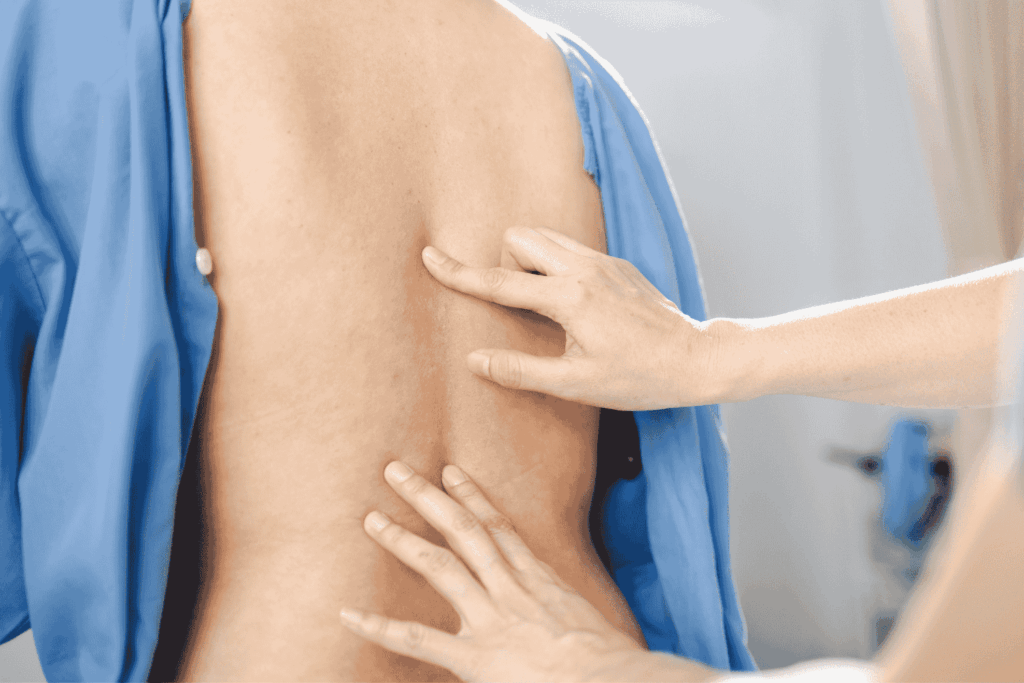
Before I assess an image, there is always the clinical examination. I look at how the
This is followed by the
Only the combination of clinical observation, X-ray image, and classification enables a reliable assessment.
Modern treatment options in Berlin
A scoliosis needs a treatment that is not schematic but fits the person. In many cases, the course can be stabilized with targeted treatment – sometimes even significantly improved. The basis is always a clear line: first understand, then act. The therapy depends on the age, the severity, the Cobb angle, and the actual complaints in everyday life.
Conservative measures are at the beginning. These include physiotherapeutic approaches, targeted movements, strengthening the back muscles, and – for certain forms and courses – the corset, which plays an important role in childhood and in the growth phase. In adults, it helps to reduce muscular imbalances, adjust loads, and stabilize the back so that the quality of life noticeably increases.
If conservative methods are not sufficient or the curvature continues to increase, we examine surgical options. An operation is not a quick fix – it is a tool that we only use when the benefit clearly outweighs the risks. Modern spinal surgery works precisely, gently, and with clear standards. Scoliosis operations may be necessary if malpositions increase, the statics tip, or the pressure on structures such as the spinal cord increases. The goal of every correction is to stop the progression, improve the statics, and prevent consequential damage.
In orthopedics and trauma surgery, much has changed in recent years: more precise planning, safer techniques, more stable implants. All of this flows into the individual decision. The MEOCLINIC offers an environment that combines modern technology with personal care – without time pressure, without automatisms.
Living with scoliosis – everyday life, movement, quality of life
Living with scoliosis does not mean having to give up an active life. Most patients can manage their everyday lives well if they know how their back works and what is good for it. The decisive factor is the combination of sensible stress, stable musculature, and good body awareness. Many people report that their quality of life improves as soon as they understand which movements are helpful and which unnecessarily stress the back.
Regular sport is expressly desired. What is important is not the perfection of an exercise, but the continuity: controlled
For children, adolescents, and adults: The better you know your body, the easier an active everyday life will be. Small adjustments – when sitting, carrying, training – often have more effect than you think. And if new complaints occur, you should take them seriously, not dramatize them. Many changes are easily treatable if you recognize them early and address them in a targeted manner.
Expertise, trust, and next step
A scoliosis is an individual clinical picture – and the treatment should be just as individual. In specialized clinics such as the MEOCLINIC, we combine modern spinal surgery with diagnostics that consider each patient as a whole. The first look at the side or the posture is only the beginning. What is decisive is what is behind it: the structure of the spine, the course, the resilience, and the actual complaints.
A good treatment never arises from routine. It arises from experience, time, and precision. At the MEOCLINIC, we work in an interdisciplinary manner, with clear processes and the goal of recognizing early on who benefits from conservative measures – and who can be protected from long-term consequences through a modern correction. In more complex cases, we examine whether structures such as the spinal cord are affected and which steps are medically sensible.
If you or your child suspect scoliosis or if the diagnosis has already been made, the next step is simple: a thorough assessment. We take our time, explain understandably, and plan a therapy that really suits you.
If you are ready: Make an appointment or get a second opinion.

