

Today, back pain is one of the most common reasons people seek medical attention. Many sufferers are familiar with the pattern: a long workday, little physical activity, prolonged sitting – and your back starts to ache. Often recurring, sometimes so severe that normal daily activities become a challenge. However, back pain is not an unavoidable fate. It has causes that can be understood – and effectively treated.
Why Back Pain Is So Common Today
In front of the computer, on the couch, and in the car. We sit – and sit – and sit. Far too long and often without adequate compensation. The result: back pain that recurs repeatedly or even becomes chronic. Prolonged standing, such as in sales, as well as heavy lifting in trades or industry, also places significant strain on the back. Additionally, stress, insufficient breaks, and monotonous movement patterns contribute. Our backs must endure a great deal, yet we provide them with too little variety, insufficient movement, and inadequate active muscle support.
From an evolutionary perspective, we were hunters and gatherers, constantly in motion. Today, we often remain in the same position for hours – at a desk, in a car, or in front of screens. This explains why back pain is one of the most common reasons people in Germany seek medical advice. Many sufferers experience tension, which sometimes radiates into their arms or legs, while at other times it remains a persistent ache along the spine. Back complaints occur across all age groups and affect individuals of every gender. They are a widespread affliction – but one that can be treated and prevented.

Causes: What Truly Lies Behind Back Pain
Back pain can originate from various sources. It often begins with a stabbing sensation in the lower back, which varies in intensity from day to day. Sometimes it is due to poor posture, sometimes muscle tension, or sometimes overuse. In other cases, a spinal condition is the cause, such as a herniated disc, inflammation, or a chronic illness like rheumatism or ankylosing spondylitis. Headaches or neck pain are also frequently associated with back problems. Numerous forms and areas can trigger discomfort – sometimes it is a single cause, sometimes several simultaneously.
Even everyday factors such as lack of physical activity, stress, insufficient breaks, or monotonous work routines can exacerbate lower back pain. International terms like “back pain” or “et al.” also constantly appear in studies, highlighting that back pain is a global issue. Crucially: Every cause presents differently – and each requires an appropriate treatment.
Poor Posture, Lack of Physical Activity, and Overuse
Many complaints arise from a lack of physical activity. Individuals who engage in insufficient physical activity lose the stabilizing core muscles that protect the back. As a result, the back and neck muscles work harder, become tense, painful, and more sensitive. The lumbar spine, in particular, bears a significant load. It serves as the pivotal point between the upper body and legs. Muscular imbalances, insufficient training, overweight, and unilateral stresses also play a role.
Poor postures – whether while sitting, standing, or lifting – are also a common cause of back pain. Some sufferers unconsciously strain the same side or avoid painful movements. Over time, this can lead to muscle tension, pain, or overuse. The legs can also be involved: for instance, if movement patterns are not harmonious or if one leg bears more load when walking. Often, a thorough examination is required to reveal which structures are overloaded.
Spinal Conditions such as Thoracic Spine Syndrome, Ankylosing Spondylitis & More
In addition to functional causes, there are also structural conditions. These include Thoracic Spine Syndrome, conditions such as ankylosing spondylitis, rheumatism, or acute herniated discs. Some manifest in young adults. Others develop over the years and affect men and women equally. They can predispose to poor posture, trigger chronic inflammation, or exacerbate degenerative changes. Appropriate prevention – physical activity, targeted training – often helps to positively influence the progression of these conditions. It is important to note: Each condition presents differently. Therefore, an individual analysis by an experienced specialist is required.

Symptoms: When Back Pain Indicates More Than a Mere Ache
Back pain can manifest as a dull, stabbing, burning, or radiating sensation. Some sufferers experience discomfort only in the lower back, while others feel it in the neck, along the arms, or even extending into the chest. For some, the pain may shift sides. Lower back pain can appear suddenly or develop gradually. Neck pain often occurs concurrently – particularly with stress or prolonged screen work. It is crucial to observe whether symptoms change, radiate into the legs or arms, if numbness occurs, or if mobility is restricted. The more clearly the symptoms are described, the more precisely the underlying cause can be identified.
Diagnosis: First Understand Back Pain, Then Treat
At the Wirbelsäulen-Clinic Berlin, diagnosis adheres to a clear principle: first understand – then treat. The spine is a complex system involving numerous organs, muscles, nerves, and joints. Therefore, thorough examinations are required that extend far beyond simple palpation. Modern imaging techniques such as MRI and CT provide precise data, detailing intervertebral discs, bones, nerves, and musculature. In many cases, functional analyses or clinical stability tests are also performed.
Patients often realize the importance of a clear diagnosis during the discussion of their findings. Many questions can only be answered once the physician has consolidated all available information – examinations, images, symptoms, and progression. There is no routine, no hasty decisions. Each case is evaluated individually. This is the rule, not the exception.
Modern Examinations for Clear Findings
In addition to classical imaging, state-of-the-art analytical procedures are employed today. They reveal structures in detail without burdening the body. While many patients gather information online or through media such as Adobe infographics, a personal examination remains indispensable. Only the interplay of experience, clinical insight, and technology enables a precise diagnosis.
Treatment: From Movement to Therapy – What Truly Helps
The better the underlying cause is understood, the more targeted the treatment can be. Often, physical activity, training, physiotherapeutic exercises, or lifestyle adjustments are sufficient. Pain relievers can offer short-term relief but are not a long-term solution. The goal is to achieve relief, improve mobility, and reduce limitations.
Costs also play a role, but they are usually lower if appropriate treatment begins early. It is important for patients to understand: Back pain does not automatically signify damage. The spinal structures are stable, adaptable, and capable of regeneration.
Conservative Therapy
Conservative treatment is almost always the initial step. It encompasses movement therapy, targeted strengthening, core muscle training, relaxation techniques, heat therapy, or manual therapy. In many cases, this approach can prevent pain from becoming chronic. Pain relievers can provide supportive effects but should be used judiciously. The aim is to assist the body in healing, not to immobilize it. Nothing replaces targeted physical activity and the development of back and abdominal musculature. It is crucial to recognize and correct poor postures and to abandon harmful movement patterns.
Minimally Invasive Procedures When Necessary
If conservative methods are insufficient, minimally invasive procedures offer a gentle way to specifically alleviate pain. Today, the spine can be treated with the utmost precision: minimal access points, microscopic techniques, and exact instruments. This preserves tissue, and the use of modern procedures enables rapid mobilization. In some cases, a minimally invasive approach is the best course of action – but never without a clear diagnosis. The decision here depends on the nature of the condition, the individual case, and the objective of achieving the best possible outcomes.
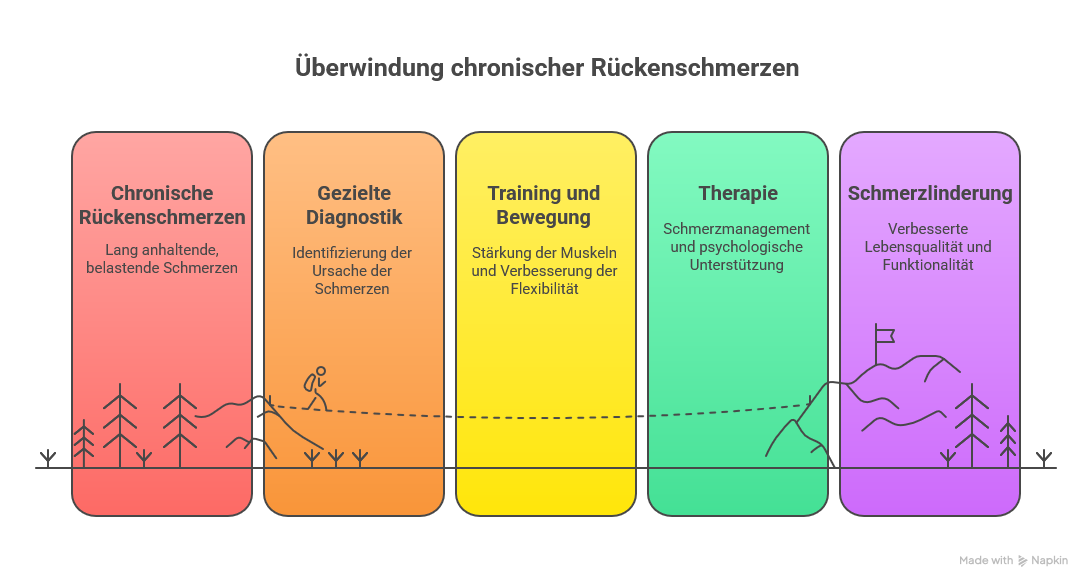
Chronic Back Pain: When the Pain Persists
Chronic back pain often develops over months or years. It arises when acute discomfort does not fully resolve or when pathological changes in the spine are present. It can affect cognitive function, limit quality of life, and complicate daily activities. Millions of people in Germany are affected. However, even chronic conditions can be improved – with targeted diagnostics, training, physical activity, therapy, and sometimes minimally invasive measures. It is important not to despair: even long-standing pain is treatable.
Trust & Expertise: Why Thorough Analysis Is Crucial
Back pain is highly individual. Therefore, it requires experience, careful consideration, and precise diagnostics. Many patients report in testimonials how crucial it was to finally receive a clear explanation and an understandable treatment plan. The physician’s role is not only professional but also emotional: listening, understanding, explaining, and making decisions collaboratively. At the Wirbelsäulen-Clinic Berlin, the individual is at the forefront – not the imaging, not the technology, but the patient’s unique situation. Information is explained clearly, and questions are answered patiently.
Next Step: Individual Consultation at the Wirbelsäulen-Clinic Berlin
If you are experiencing back pain or have already received a diagnosis, a personal consultation is highly recommended. An experienced physician will take the time to explain findings, clarify alternative approaches, and outline sensible next steps. The goal is to alleviate pain, restore mobility, and provide long-term assistance. Whether for acute discomfort, chronic pain, or unclear diagnoses – an appointment at the Wirbelsäulen-Clinic Berlin is the first step towards an improved quality of life.

